What ChatGPT, Gemini and Perplexity check before they name a store, and a step-by-step plan to make your product pages the answer they pick.
Rizecart team··7 min read
Perplexity
AI answer · 3 hours ago
Official APINot named
A shopper asked
Best long-lasting oud perfume I can get delivered to Dubai by Thursday?1
For oud that lasts in the Gulf heat, look for an extrait or an oil rated 8+ hours on skin. Two options that reach Dubai before Thursday:
1. Sahra Oud 75 ml from Dar Al Oud. In stock, delivered to Dubai in 2 days.
2. Qamar Oud 50 ml from Misk House. Free next-day delivery in Dubai.
Both are in stock today.
Stores it named
1Dar Al Oud
2Misk House
Misk Al Ofuq· Not named
Sources it used
yyoutube.comSocial
aamazon.aeMarketplace
The short answer
ChatGPT recommends stores whose pages prove they fit the shopper's question. It checks that the product is in stock, the price is readable, delivery and returns are clear, the facts are specific, its crawler can open the page, and other sites mention you. Fix those on your best sellers, in Arabic and English, then ask the same questions again every week.
Key takeaways
AI assistants pick stores from facts they can read: stock, price, delivery, returns and specs.
If robots.txt or your firewall blocks AI bots, or details load by JavaScript, the AI sees nothing.
Mentions of your store on other sites track AI visibility far more closely than backlinks.
Write the same facts in Arabic and English, because shoppers ask in both.
Ask your buyers' real questions every week and record which stores get named.
How does ChatGPT decide which store to name?
When a shopper asks ChatGPT what to buy, it searches the web, reads product pages and writes a short list. OpenAI says its shopping results weigh availability, price, quality, and whether the merchant is the maker or main seller. Gemini, Perplexity and Claude work in a similar way. They read what your pages say, and what other sites say about you.
The questions have changed too. Nobody types “perfume” anymore. They ask for the “best oud under $100 delivered to Doha by Thursday”. Every detail in that sentence is a filter. The budget, the city and the delivery day each knock out the stores that don't state them. The AI isn't judging whose oud smells better. It's checking whose page proves it fits.
That's why good stores lose to weaker ones. Not on price, not on quality, but because the AI couldn't find the facts.
Is AI traffic worth the effort?
It's still small, but it buys. Adobe found that AI referrals to US retail sites grew 62% in a year and converted 60% better than other traffic in July 2026. In the Gulf, a Tabby survey of more than 20,000 shoppers in Saudi Arabia and the UAE found that 43% use AI to decide what to buy.
Studies don't all agree. One study of 973 sites found ChatGPT sent under 0.2% of sessions, and converted worse than organic search in that sample. What isn't in dispute: the shopper now decides inside the answer. If your store isn't named, you're not in the running.
What does the AI look at before it names a store?
Seven things come up again and again. Here they are, with the place stores usually go wrong.
What the AI checks
What it needs to find
Where stores go wrong
Stock
“In stock” in the page text and the page data
Stock shown only by the colour of a button
Price
A number and currency it can read, the same everywhere
Price inside an image, or different on the page and in the feed
Delivery
Delivery time and shipping price to the shopper's city
“Fast delivery”, with no days and no cities
Returns
A return policy it can find and read
No policy, or one hidden in a PDF
Product facts
Size, materials, origin, specs, what's in the box
Adjectives like “premium” and “best quality”
Access
Pages its bot may read, with the details in the HTML
AI bots blocked, or details loaded by JavaScript
Reputation
Other sites that mention and review your store
Nobody outside your store talks about you
The last row matters more than most owners expect. Ahrefs studied 75,000 brands and found that mentions of a brand across the web tracked its AI visibility far more closely than backlinks did. It's a correlation, not proof. But it points the same way as everything else: the AI trusts what other people say about you.
Start with your 20 best-selling products and work through these in order. Most steps have a short lesson in the Academy course Fix what the AI can't see.
1
Write down the questions your buyers ask
Not “oud perfume”, but the whole question, with the city, budget, occasion and delivery day. Write them in Arabic and English. They are the test your pages have to pass. How to choose them.
2
Let the AI bots in
Check that your robots.txt allows the search bots: OAI-SearchBot and ChatGPT-User for ChatGPT, Claude-SearchBot for Claude, PerplexityBot for Perplexity, plus Googlebot and Bingbot. OpenAI says ChatGPT's shopping research skips sites that block automated access. Check your firewall or CDN too. Which AI crawlers to allow.
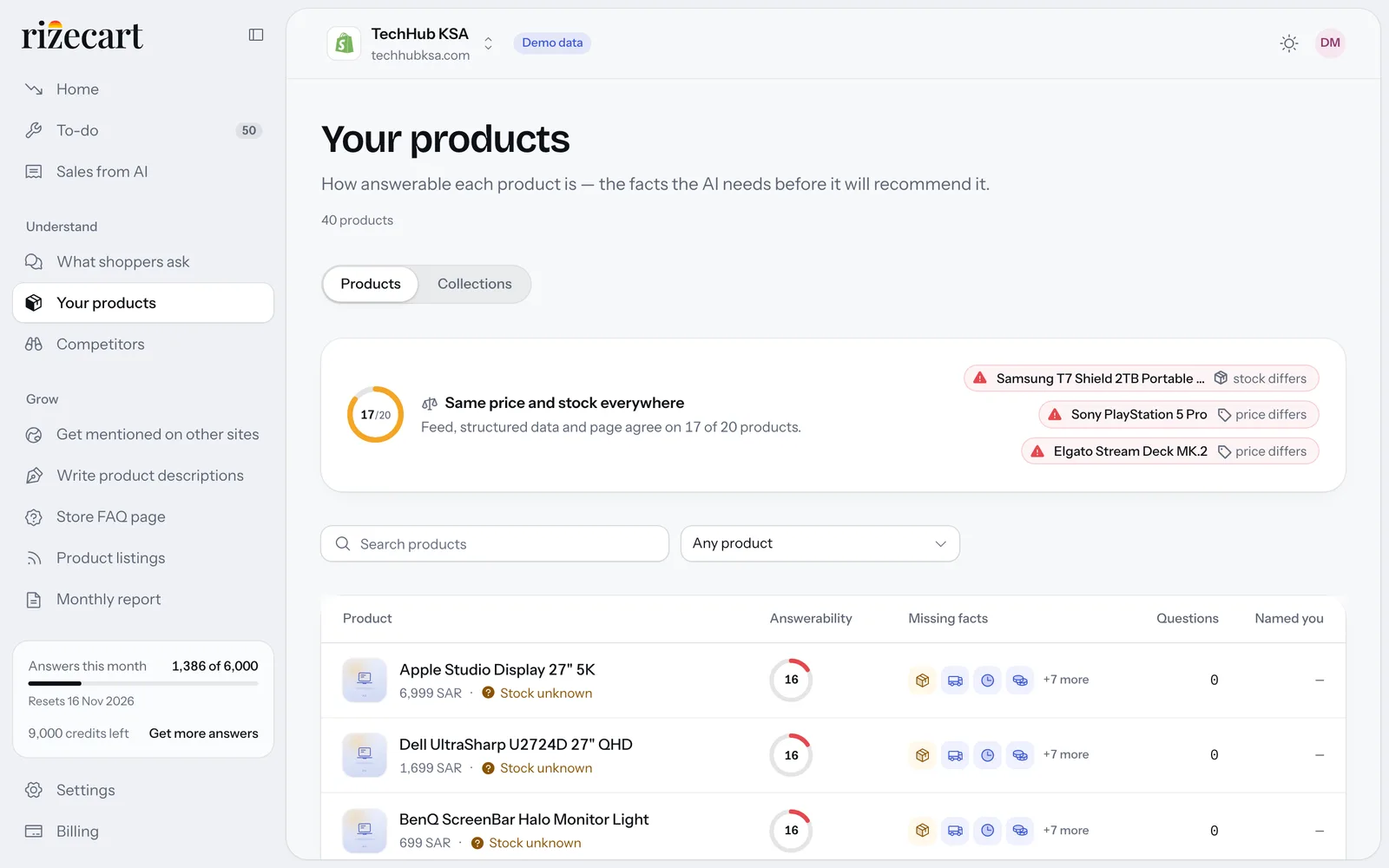
Size, weight, materials, origin, how long it lasts, what's in the box. In the Princeton GEO study, adding statistics, quotes and sources lifted visibility in AI answers by up to 40% in a test benchmark. Lesson: product facts that win.
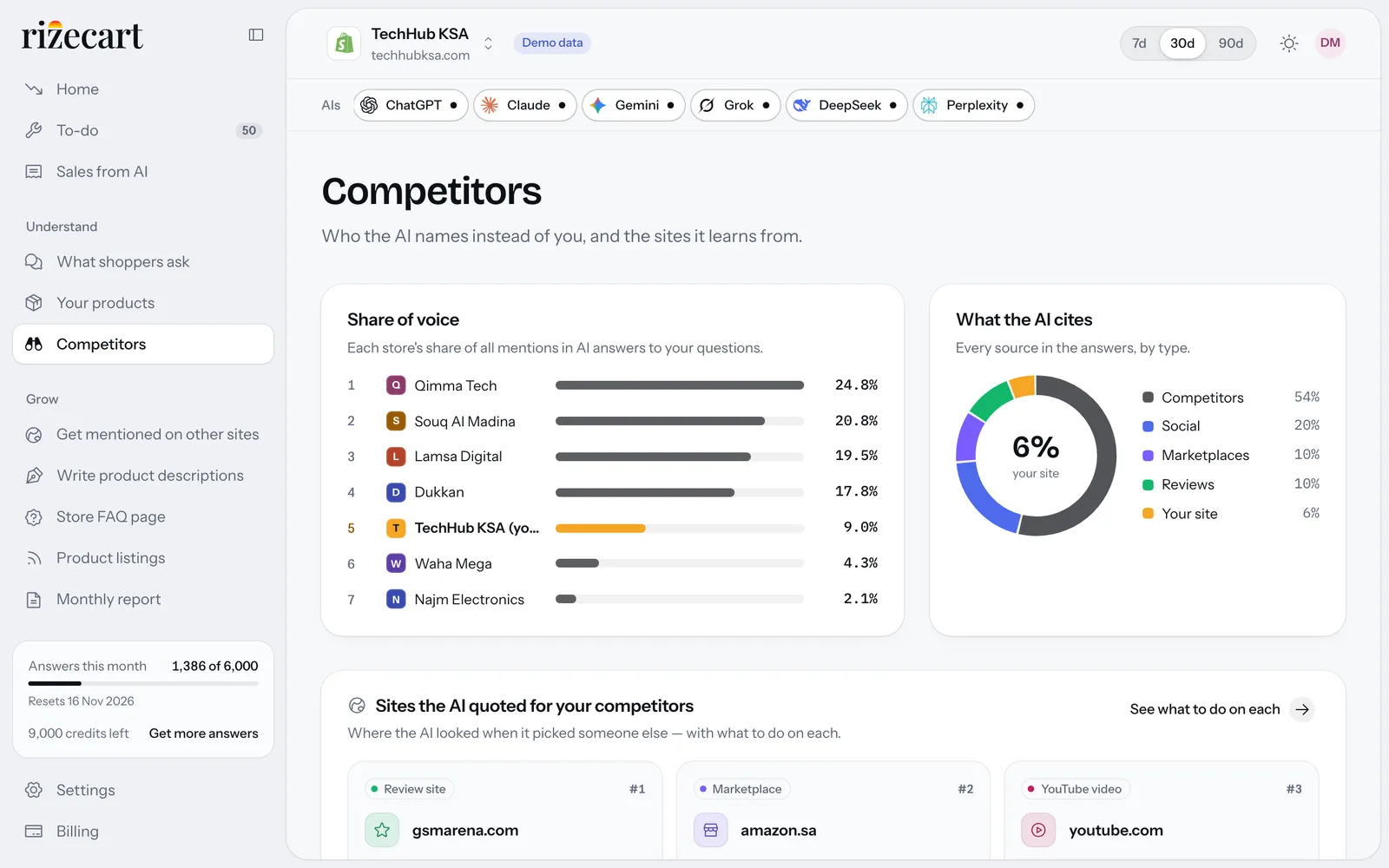
Ask every buyer for an honest review, not only the happy ones. Send samples to YouTube reviewers with no conditions on what they say, and earn a place on the sites the AI already cites for your competitors. Never buy fake reviews. They put your store at risk. The lesson Get mentioned on the sites the AI quotes shows how, site by site.
How do you check where you stand?
You can test it by hand in an hour.
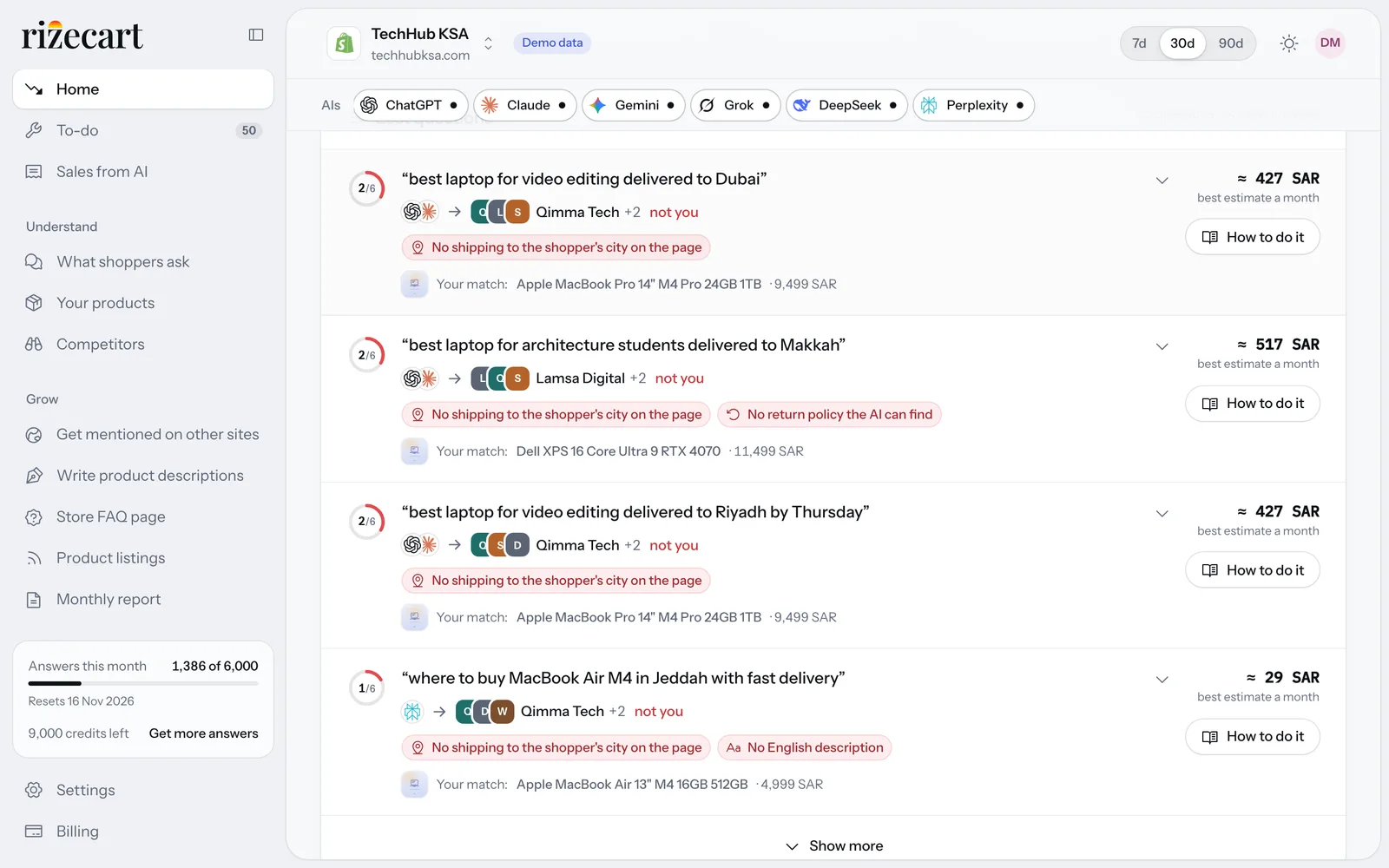
Rizecart's lost questions: where the AI named someone else, and why.Demo store data
Open ChatGPT, Gemini and Perplexity. Ask each one five of your buyers' questions, in Arabic and in English.
Write down which stores are named, in what order, and which sites each answer cites.
Open the named stores' product pages. Compare them with yours, fact by fact: price, stock, delivery, returns, specs and language.
Repeat a week later. Answers change with wording, language and location, so one try isn't a verdict.
Or start with the free store check. It reads your store the way ChatGPT, Claude and Perplexity do: product data, prices, delivery facts, Arabic content, and which AI bots your robots.txt allows. It takes two minutes and needs no card.
Keyword stuffing. Repeating “best oud Dubai” ten times doesn't give the AI a single fact to quote.
Waiting for in-chat checkout. Buying inside ChatGPT is US-only today, and OpenAI moved Instant Checkout into apps in March 2026. What wins in the Middle East now is being the store the AI names, so the shopper clicks through to you.
Promises of a #1 spot. Nobody controls what an AI recommends. Anyone who guarantees a ranking is guessing.
Keep asking, keep score
Fixing the facts once isn't the end. Competitors change their prices, the AIs change how they answer, and new questions appear. The stores that win keep asking the same questions and watching who gets named.
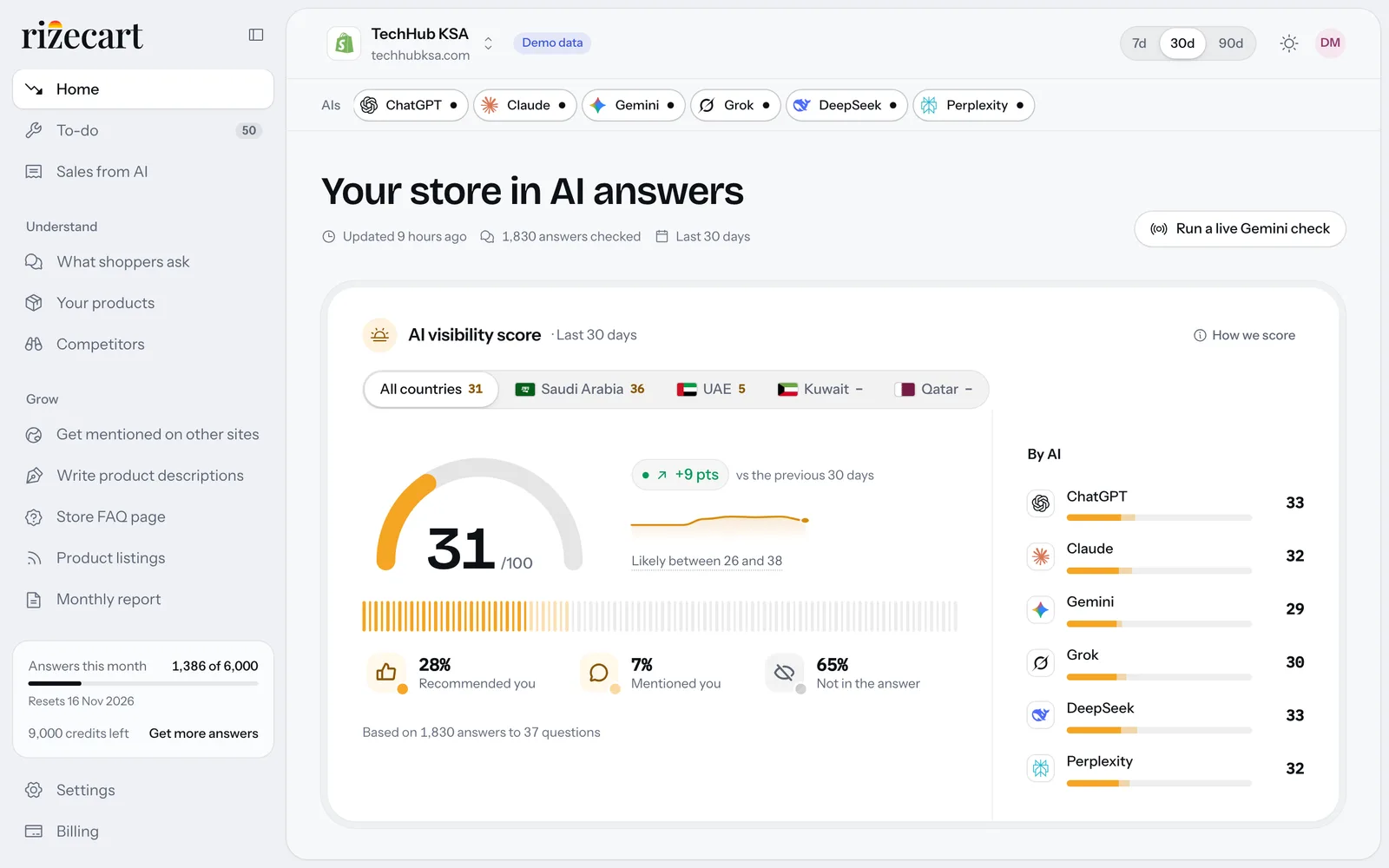
That's the loop Rizecart runs for Shopify, Salla, Zid and WooCommerce stores every week. It asks up to six AIs, including ChatGPT, Gemini, Perplexity and Claude, your buyers' real questions, and turns the answers into one AI visibility score. Where you're losing shows which store was named instead of you, and why. Rizecart writes the fix into your store once you approve it (or applies safe fixes by itself, if you turn that on), lets you undo any change, and counts the orders that come back under a published attribution rule. See the plans.
Questions
Can I upload my products directly to ChatGPT?
Not from the Middle East yet. OpenAI's product feed format currently targets the US and is open to approved partners. Shopify stores can be included through Shopify Catalog, where Agentic Storefronts are on by default for eligible stores. For Salla, Zid and WooCommerce stores, ChatGPT finds you by reading your public pages, so those pages need to carry every fact.
How long until ChatGPT recommends my store?
Nobody can promise a date. AI crawlers revisit pages on their own schedule, and the AI decides who to name. What you control is whether every fact it needs is on the page. Ask the same questions every week and you'll see when the answers start to change.
Does ChatGPT read Arabic product pages?
Yes. ChatGPT reads and answers in Arabic, and it's the most downloaded AI app in Saudi Arabia, ahead of Gemini and DeepSeek, according to the CST's internet report. When a shopper asks in Arabic, a page that states the facts in clear Arabic gives the AI something to quote.
Do I have to fix every product at once?
No. Start with the products behind the questions you lose most, usually your best sellers. Fix the facts on 20 products, check again, then move on to the next batch. In Rizecart, the Next best fixes list puts them in order for you.
Is SEO still worth doing?
Yes. Google says its AI features have no extra requirements beyond normal search best practice. Ranking in Google and being named by an AI rest on the same base: pages that are open, accurate and specific. SEO, GEO and AEO explained.
The AI bots from OpenAI, Anthropic, Google, Perplexity and Meta: which to allow, a robots.txt to copy, and how to test that your CDN isn't blocking them.
Rizecart team··7 min read
Find out which questions you're losing. Free, in two minutes.