The short answer
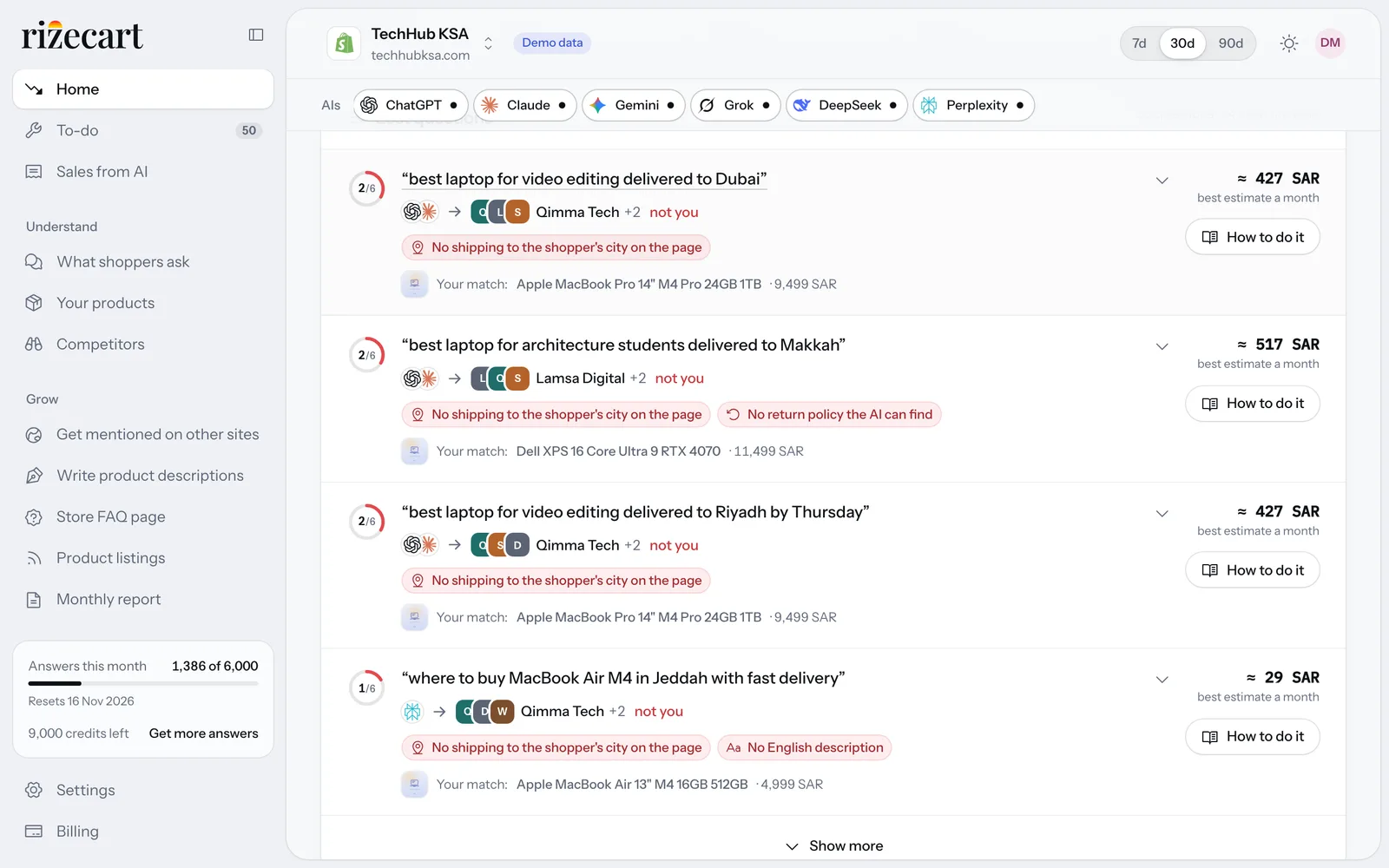
ChatGPT names the store whose pages answer the shopper's whole question. When it picks a competitor, it has often found a fact on their page that was missing from yours: delivery time to the shopper's city, a price it could read, a clear returns policy, full specs, Arabic content, or mentions on other sites. Add the missing fact and you're back in the running.
Key takeaways
- The AI picks the page that answers every part of the question, not the best product.
- Delivery time to a city, a readable price and a visible returns policy are easy to miss and quick to fix.
- Thin specs and weak Arabic lose questions your products could win.
- Blocking AI crawlers, by mistake or on purpose, takes you out of the answer.
- Reviews and mentions on other sites help the AI trust a store.
One question, two stores
A shopper asks ChatGPT for the “best oud under $100 delivered to Doha by Thursday”. You sell a fine oud oil at $89. It's in stock, and you deliver to Doha in two days. ChatGPT names two other stores. Here's what it likely found when it read the pages side by side.
| What the question needs | The competitor's page | Your page |
|---|---|---|
| Under $100 | “$89” as text, and in the page data | Price inside a banner image |
| Delivered to Doha | “Delivered to Doha in 1-2 days” | “Fast delivery across the Gulf” |
| By Thursday | Delivery days listed for each city | No delivery time at all |
| In stock | “In stock” on the page | Only an “Add to cart” button |
| Is it good? | “Cambodian oud oil, 12 ml, lasts 12+ hours”, with 40 reviews | “High quality oud oil, excellent scent” |
| Safe to buy? | “Free returns within 14 days”, linked | No return policy on the page |
Your oud may well be better. The AI can't smell it. It can only check which page proves it fits the question, and yours didn't. OpenAI says its shopping results weigh availability, price, quality, and whether the merchant is the maker or main seller. Every missing fact is a reason to name someone else.
Which facts go missing, and what should you change?
Here are seven common reasons, with what to change for each. The table after them uses the exact words Rizecart shows when it flags one.
1. No delivery time to the shopper's city
Why you lose: “Fast delivery” isn't a fact. When the question names a city and a day, the AI looks for both. What to change: write delivery times by city on the product page, in plain text: “Delivered to Dubai in 1-2 days, Riyadh in 2-3 days, Kuwait City in 3-4 days.” Lesson: delivery times by city.
2. A price the AI can't read
Why you lose: the price sits in an image, loads by script, or differs between the page and your product feed. The crawlers behind ChatGPT, Claude and Perplexity don't run JavaScript. What to change: show the price as text with its currency, and make sure the page's Product and Offer data matches the price shoppers see. Show the shipping price too, because OpenAI's feed rules treat a missing shipping price as unknown, not free. Lesson: prices and stock an AI can read.
3. No visible returns policy
Why you lose: someone buying a gift, or buying from you for the first time, wants to know they can send it back. If the AI can't find your policy, it can't reassure them. What to change: publish a returns page in plain words (how many days, who pays, how to start) and link it from every product page. Google also suggests stating your shipping and return policies once for the whole store in your structured data. Lesson: shipping and returns policies.
4. Thin specs
Why you lose: comparison questions like “Cambodian or Indian oud, which lasts longer?” need facts to compare. Adjectives give the AI nothing to quote. What to change: add size, weight, materials, origin, what's in the box and how to use it. In the Princeton GEO study, adding statistics, quotes and sources lifted visibility in AI answers by up to 40% in a test benchmark. Lesson: product facts that win.
5. Weak or missing Arabic
Why you lose: many of your buyers ask in Arabic. In Saudi Arabia, 45.2% of internet users now use AI tools, and ChatGPT is the most downloaded AI app there. A machine-translated page often bends or drops the very facts the question asks about. What to change: write the Arabic page with the same facts as the English one, in natural Arabic. See the lesson Arabic and English content and our guide to Arabic product pages an AI can read.
6. Your store blocks AI crawlers
Why you lose: one line in your robots.txt, or a bot rule at your CDN or firewall, stops the AI's bot at the door. OpenAI says ChatGPT's shopping research skips sites that block automated access. What to change: allow the search bots, such as OAI-SearchBot, ChatGPT-User, Claude-SearchBot, PerplexityBot, Googlebot and Bingbot. Training bots like GPTBot are a separate choice, as OpenAI's crawler page explains. Which AI crawlers to allow.
7. Few sites mention your store
Why you lose: the AI trusts stores that other people talk about. Across 75,000 brands, Ahrefs found that mentions of a brand on the web tracked AI visibility far more closely than backlinks did: about 0.66 for mentions, with links far weaker. What to change: look at the sites the AI cites for your competitors, then earn a place there: a review, a listing, a comparison article, a YouTube video. Ask real customers for reviews. Never buy fake ones. In Rizecart, Get mentioned lists the sites the AI quoted for your competitors, with one step for each that keeps to the site's rules.
The quick fix list
| What Rizecart flags | What to change | Lesson |
|---|---|---|
| No delivery time on the product page | Add delivery days by city to the page text | Delivery times by city |
| The AI can't read your price | Price as text, matching the page data and the feed | Prices and stock |
| No return policy the AI can find | A plain returns page, linked from every product | Shipping and returns |
| Key specs are missing | Size, materials, origin, what's in the box | Product facts that win |
| No Arabic description | The same facts, written in Arabic | Arabic and English content |
| Your site blocks AI crawlers | Allow the AI search bots in robots.txt and your firewall | AI crawlers guide |
| Few sites mention your store | Reviews and mentions on the sites the AI cites | Get mentioned on the sites the AI quotes |
How do you find the fact you're missing?
- Ask the question yourself in ChatGPT, Perplexity and Gemini, in the language your buyer would use.
- Open the stores the AI named, and the sources it cited.
- Put their product page next to yours and go down the table above, fact by fact.
- Fix the first missing fact, give the bots time to read the page again, then ask again.
Doing this for every question and every AI gets slow. The free store check shows in two minutes which of these facts your store is missing. Once your store is connected, Rizecart's Where you're losing screen lists each question where an AI sent the buyer elsewhere, who it named, and Why you weren't named. How to read that screen.
What can't content fix?
Be honest with yourself here. If a competitor sells the same product for less, or you're out of stock, the AI is right to name them. And nobody controls what an AI says. Fixing the facts makes your store a valid answer, it doesn't guarantee the pick. What it does is stop you losing questions you should be winning.
Questions
Why does ChatGPT recommend a bigger store when mine is cheaper?
If I fix these, will ChatGPT recommend my store?
Why does ChatGPT give a different answer each time I ask?
Which fact should I fix first?
Sources
- OpenAI Help Center: Shopping with ChatGPT search
- OpenAI: Product feed specification
- Google Search Central: Merchant listing structured data
- Vercel: The rise of the AI crawler
- Aggarwal et al., GEO: Generative Engine Optimization (KDD 2024)
- Asharq Al-Awsat: Saudi Arabia's use of AI tools surges to 45.2% (CST report)
- Ahrefs: AI brand visibility correlations (75,000 brands)
- OpenAI: Overview of OpenAI crawlers