The short answer
Write Arabic product pages as facts, not slogans, and make them say exactly what your English page says: the same price, size, materials, delivery time and returns. Write the Arabic natively instead of machine-translating it, write units and numbers one consistent way, and keep both versions readable by AI bots. Then an AI can quote you in whichever language the shopper asks.
Key takeaways
- Shoppers across the region ask AI in Arabic, so your Arabic page has to answer on its own.
- Machine-translated Arabic often bends or drops the facts the question asks about.
- Your Arabic and English pages should state the same price, size, materials, delivery and returns.
- Write units, numbers and city names one consistent way in both languages.
- Both versions must show their details in the HTML, not load them by script.
Why do shoppers ask AI in Arabic?
Because it's the language they think and shop in. In Saudi Arabia, the CST's internet report found that 45.2% of internet users now use AI tools, more than double the year before. Searching for information is the top use, and ChatGPT is the most downloaded AI app there, ahead of Gemini and DeepSeek.
45.2%
Shopping is part of it. A Tabby survey of more than 20,000 shoppers in Saudi Arabia and the UAE found that 43% use AI to decide what to buy, but only 30% fully trust it. That gap is your opening. Clear, specific facts in the shopper's own language are how a store earns the trust the AI's answer lacks.
43%
When a buyer in Riyadh, Kuwait City or Cairo asks in Arabic, the AI looks for a page that answers the question. If your Arabic page is thin, a rough copy of the English, or missing, you've given it nothing to quote.
Why does machine-translated Arabic lose?
Machine translation makes a fine first draft. Published as it is, it costs you questions. These are the usual problems:
- The words aren't the shopper's words. A literal translation may use the textbook word for oud oil (zayt al-oud) where Gulf buyers ask for dihn oud, or the formal spelling of abaya when they type the everyday one. If your page doesn't use the shopper's words, it's harder to match to the question.
- Delivery changes meaning. “Ships in 24 hours” can come out in Arabic as “shipping happens within 24 hours”, which says when the parcel leaves, not when it arrives. The shopper asked when it arrives.
- Units and numbers get mixed up. “12ml” turns into a jumble of Arabic and Latin letters, digits switch style halfway down the page, or a range like “1-2 days” flips around in right-to-left text.
- The two pages drift apart. You update the English price or size and forget the Arabic. Now the AI sees two stories about one product, and your page data may no longer match what the page shows.
- It reads like a machine. Stiff, word-for-word Arabic tells the shopper nobody at the store speaks their language. That costs you trust before it costs you a sale.
How do you write facts that match in both languages?
Keep one fact sheet per product and write both pages from it. These are the facts that matter most, with a way to write each one.
| Fact | Example | Rule (the Arabic page says the same) |
|---|---|---|
| Price | $99 | Same number and currency as your feed, written as text |
| Volume | 12 ml | Same unit, same digits |
| Size | 30 × 20 × 10 cm | Same order: length, width, height |
| Material | 100% cotton | Name the material, don't just say “premium” |
| Origin | Cambodian oud | Use the name shoppers use |
| Delivery | Delivered to Doha in 1-2 days | Arrival time, for each city |
| Returns | Returns within 14 days | Days, who pays, how to start |
A few rules hold it all together:
- One digit style. Use Western digits (1, 2, 3) for prices, sizes and dates in both languages, so they match your product feed and your English page.
- One spelling per city. Riyadh, Dubai, Doha, Kuwait, Cairo: pick the Arabic spelling your buyers use for each and keep it, every time.
- Brand names stay as they are. Write Chanel or Tom Ford, not a transliteration.
- The shopper's words come first. If your buyers say dihn oud, put it in the title and the first line.
- One fact per line. Short lines are easier for a shopper to scan and for an AI to quote.
Before and after: one product, both languages
Here's an oud oil page, before and after. The product didn't change. The facts did.
| Before | After | |
|---|---|---|
| English | High quality oud oil, excellent scent, best price. | Pure Cambodian oud oil, 12 ml, lasts 12+ hours. $99. Delivered to Doha and Dubai in 1-2 days. |
| Arabic | The same three empty claims, in Arabic | The same facts, in Arabic: Cambodian oud oil, 12 ml, lasts 12+ hours, $99, delivered to Doha and Dubai in 1-2 days |
Now look at what each fact answers. “Cambodian” answers a comparison question like “Cambodian or Hindi oud?”. “12 ml” and “$99” answer the budget. “1-2 days to Doha” answers “by Thursday”. The old version answers nothing, in either language. That matches the research: in the Princeton GEO study, pages that added statistics, quotes and sources gained visibility in AI answers by up to 40% in a test benchmark.
How do you make sure the AI can read both versions?
- Give each language its own page. On Shopify, add Arabic as a store language and translate each product. On Salla and Zid, fill in both the Arabic and the English version of every product.
- Keep the details in the HTML. The crawlers behind ChatGPT, Claude and Perplexity don't run JavaScript. If your Arabic description loads by script, they see an empty page.
- Match the page data. The structured data behind each version must match what that page shows: the same price and the same stock.
- Don't block the bots. Check that your robots.txt lets the AI search bots reach your Arabic pages too. Which AI crawlers to allow.
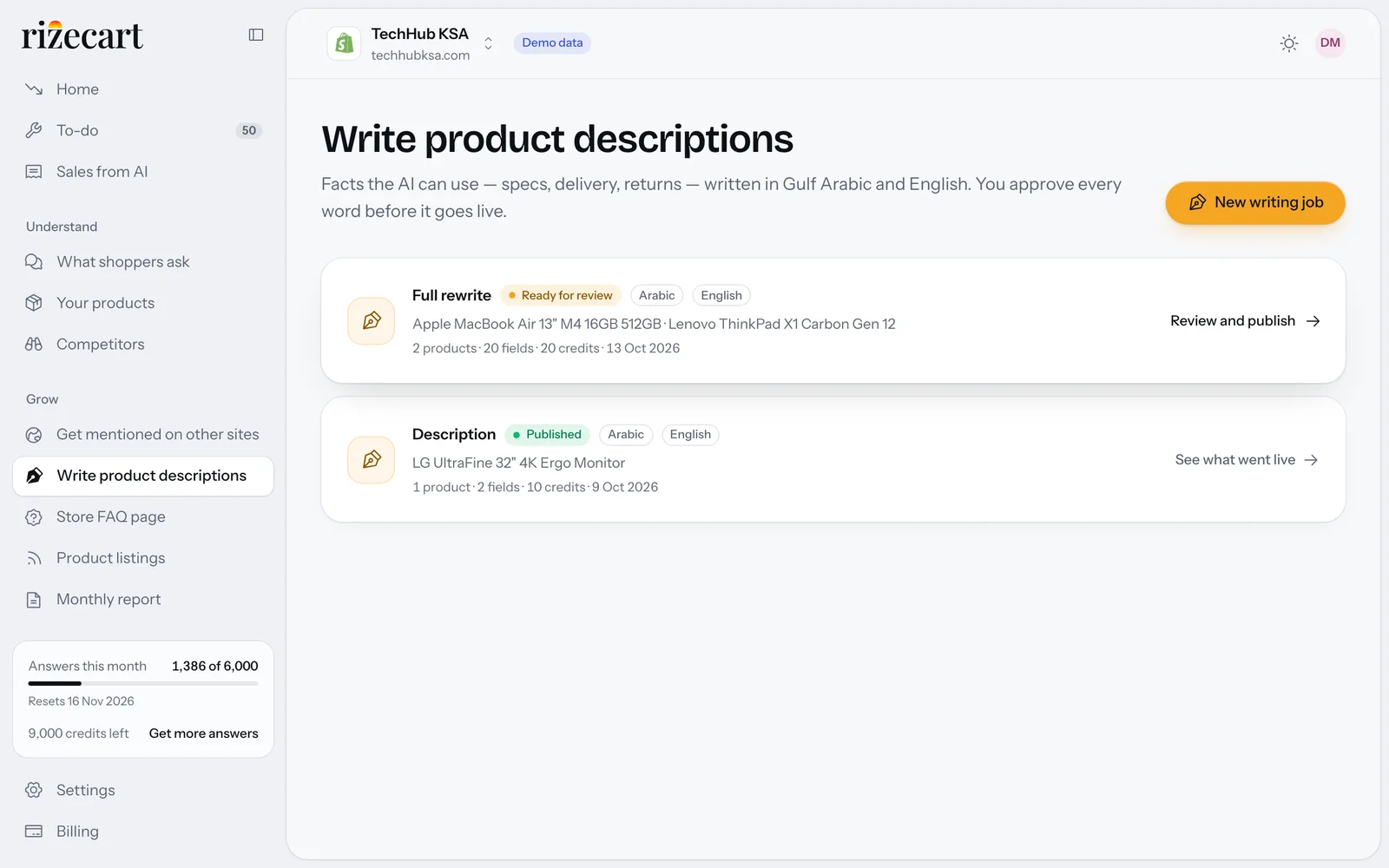
The lesson Arabic and English content walks through this step by step. In Rizecart, each product shows its Arabic and its English description and flags the one that's missing. The Content studio writes the facts in both languages, and you approve every word before it goes live.
Checklist for every Arabic product page
- The title uses the words your buyers type, in Arabic.
- The price is written as text, with its currency, and matches the English page and your feed.
- Stock is stated in words.
- Size, volume or weight uses the same unit and digits as the English page.
- Materials and origin are named, not described with adjectives.
- Delivery time is written as arrival time, for each city you serve.
- The shipping price is stated, even when it's free.
- The return policy is linked, and it's in Arabic too.
- Brand and model names are left as they are.
- The page shows its details without JavaScript, and the AI bots are allowed in.
Want to know which of these your store is missing? The free store check looks at your Arabic content, prices, delivery facts and AI bots in two minutes. For the full picture of what ChatGPT checks, read how to get your store recommended by ChatGPT.