The short answer
Read two things on each order: the landing link and the referrer. ChatGPT links have carried utm_source=chatgpt.com, Perplexity and Claude visits arrive with perplexity.ai or claude.ai as the referrer, and Gemini's referrer shows up only some of the time. Shopify and Salla save these on every order. Google AI Overviews look like ordinary Google search, so estimate them, never count them.
Key takeaways
- ChatGPT has tagged its links with utm_source=chatgpt.com (check yours: that may be changing). Perplexity and Claude show up as the referring site.
- Gemini's signal is patchy, and Google AI Overviews can't be told apart from normal Google search.
- Shopify and Salla already save the landing link, referrer and UTM tags on each order. Read them before you buy a tool.
- Some AI influence is invisible. Estimate it separately, label it, and never add it to confirmed orders.
- Rizecart counts AI orders under a published rule with three levels: confirmed, likely and not counted.
A customer tells you they found you on ChatGPT. You open your reports and see nothing labelled AI. The sale went to “direct” or “Google”, and you're left guessing whether the AI is worth your time. The good news: most AI assistants leave a trace on the order. Here's where to find it, what's missing, and how to count it honestly.
60%
The volume is still small for most stores. A study of 973 sites found ChatGPT drove under 0.2% of sessions, and those visits converted worse than Google search. Either way, each AI order is worth knowing about, and worth counting right.
What signal does each AI leave?
When a shopper clicks a link inside an AI answer, two things can travel with the visit: a tag on the link (utm_source=...) and the referrer, the site the shopper came from. Each AI handles them differently.
| AI | What arrives with the visit | How reliable |
|---|---|---|
| ChatGPT | utm_source=chatgpt.com on the link. The referrer is often missing | Good when the tag is there |
| Perplexity | Referrer perplexity.ai. No tags | Good |
| Claude | Referrer claude.ai | Good |
| Gemini | Referrer gemini.google.com, but not every time. Any tags are undocumented | Fair |
| Grok, DeepSeek, Meta AI | Referrer grok.com, chat.deepseek.com or meta.ai | Clear when present |
| Google AI Overviews and AI Mode | Nothing that separates them from Google search | None. Estimate only |
OpenAI says ChatGPT adds utm_source=chatgpt.com to the links it sends (Publishers FAQ). Google says visits from its AI features are counted inside normal “Web” search traffic in Search Console (Google Search Central). So a shopper who clicked you in an AI Overview looks exactly like one who clicked a plain search result.
How does Shopify record where an order came from?
Shopify keeps a customer journey on every order: the first visit and the last visit before the purchase. For each visit it saves the referrer URL, the landing page, the UTM tags and a source such as Google or email (Shopify docs). That's everything you need to spot a ChatGPT or Perplexity click.
- Orders after a click. The AI's tag or referrer sits on the landing page or referrer of the first or last visit.
- Orders through Shopify's AI channels. Shopify says these orders “display in your Shopify admin with channel or referrer attribution” (Shopify Help Center). The shopper may never load your storefront, so browser tools such as Google Analytics can miss them. Read them from the order itself.
- In-chat checkout is US-only today. For stores in Dubai, Riyadh, Doha or Cairo, AI orders arrive as normal website orders after a click.
What about Salla and Zid?
Salla saves the source on each order too. Order details include source, source_details (type, value, device, user agent and the utm_source, utm_medium and utm_campaign tags) and a campaign object (Salla developer docs). There are no AI-specific labels yet, so you match the tags and referrers yourself.
On Zid and every other platform, the same rule applies. If the order keeps the landing link and the referrer, you can classify it. If it doesn't, you can't, and no tool can either.
How do you set it up yourself?
List the AI sites
Use this list as your filter:
chatgpt.com,chat.openai.com,perplexity.ai,claude.ai,gemini.google.com,grok.com,chat.deepseek.comandmeta.ai.Group AI visits in your analytics
In Google Analytics 4, add a custom channel group called “AI assistants” where the session source matches the pattern below. Place it above Referral so these visits don't get mixed in with other sites.
Read the order, not only the visit
Analytics can lose a sale that the order still records. Each week, export your orders with their landing page and referrer (the Shopify customer journey, Salla's
source_details) and mark the ones that match the list.Place a test order
Ask ChatGPT and Perplexity about one of your products, click through to your store, and buy something small. Check what the order saved, then cancel or refund it. Now you know what a real AI order looks like on your platform.
Count three buckets, never one
A clear AI signal is confirmed. An AI hint without a clear click, like
utm_medium=ai, is likely. Everything else is not counted. Keep the buckets apart in every report.Ask your buyers
Add “ChatGPT or another AI” as an answer to “How did you hear about us?” at checkout or in your thank-you email. It catches some of what the referrer misses.
The pattern for step 2, as a regular expression:
chatgpt\.com|chat\.openai\.com|perplexity\.ai|claude\.ai|gemini\.google\.com|grok\.com|chat\.deepseek\.com|meta\.aiWhat is the dark AI gap?
Some AI influence never shows up on the order. That's the dark AI gap. It happens when:
- the AI app or browser strips the referrer, and the link carries no tag;
- the shopper copies your store name from the answer and searches for it on Google, or comes back days later by typing your address;
- the answer was a Google AI Overview, which counts as ordinary Google search.
It's tempting to fill the gap with guesses: call every rise in direct traffic “AI” and celebrate. Don't. If the number is inflated, you'll move budget on fiction, and you'll stop trusting the report the first time it's wrong. A smaller number you can check is worth more than a big one you can't.
The better habit: report confirmed orders as facts, and show a separate likely-AI, unattributed estimate next to them, clearly labelled. Watch how direct visits and searches for your brand name move after the AIs start naming you. That trend is a signal, not a sale.
How does Rizecart count an AI order?
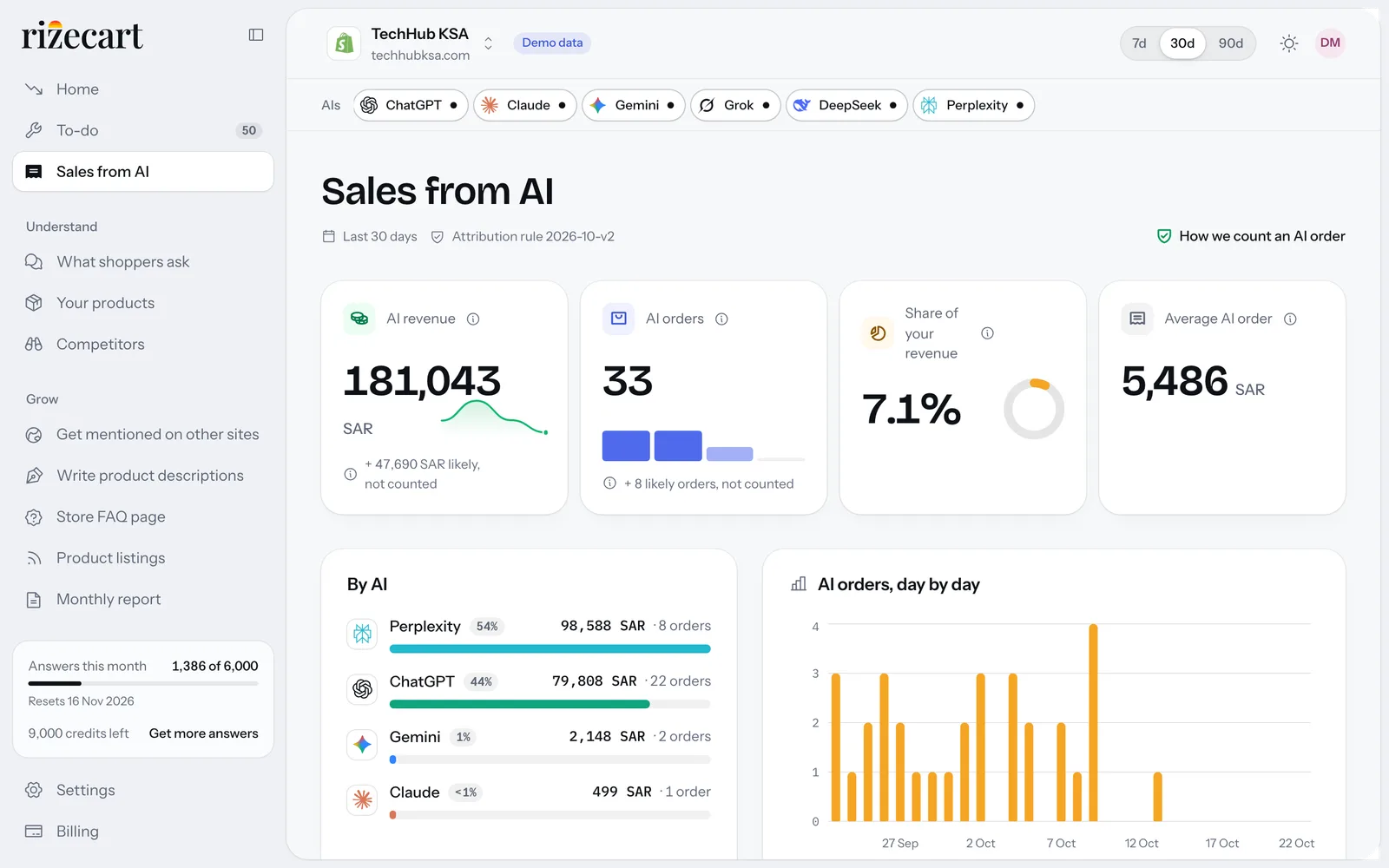
Rizecart reads each order's source, landing link and referrer from Shopify, Salla, Zid or WooCommerce (8.5 or later), and sorts it under our published attribution rule. The rule has a version number (today 2026-10-v2), and every figure on your Proof screen says which version produced it.
| Level | What the order carried | Counted as AI? |
|---|---|---|
| Confirmed AI | utm_source from an AI (like chatgpt.com), a referrer from an AI site (like perplexity.ai or claude.ai), or an AI sales channel your platform records | Yes, for that AI |
| Likely AI | An AI hint with no identifiable click: utm_medium=ai, a campaign named after an AI, or an agentic checkout channel | Shown separately, never added |
| Not counted | Google AI Overviews and AI Mode, visits with no referrer and no AI tag, and bare words like “google”, “bing”, “meta” or “x” | No |
Rizecart never adds dark AI to the order count: watch direct visits and searches for your brand name alongside it. Attribution uses only the order's source, landing link and referrer. Rizecart never stores your shoppers' names, emails, phone numbers or addresses.
For a step-by-step look inside the app, read the Academy lesson How attribution works, then Read the Proof page. To see the whole loop, from a lost question to a proven order, see how it works. And if the AIs aren't naming you yet, start with how to get recommended by ChatGPT and make sure the right AI crawlers can reach your store.
Questions
Why does ChatGPT traffic show as direct in my analytics?
utm_source=chatgpt.com tag. Apps, browsers and link settings can strip the referrer, and a report from October 2026 suggests some ChatGPT links lost the tag too. Check the order's landing link first, and treat what's left as part of the dark AI estimate.Can I track orders from Google AI Overviews or AI Mode?
If a shopper asks ChatGPT and buys a week later, does it count?
Do I need a developer to track AI orders?
Does Rizecart use my customers' personal data for attribution?
Sources
- OpenAI Help Center: Publishers and Developers FAQ
- Google Search Central: AI features and your website
- Search Engine Roundtable: OpenAI drops UTM parameters from ChatGPT results (14 October 2026)
- Shopify developer docs: CustomerVisit
- Shopify Help Center: Agentic storefronts
- Salla developer docs: Order details
- Digital Commerce 360: Adobe AI referral traffic data, July 2026
- Search Engine Land: LLM vs Google referral conversion study